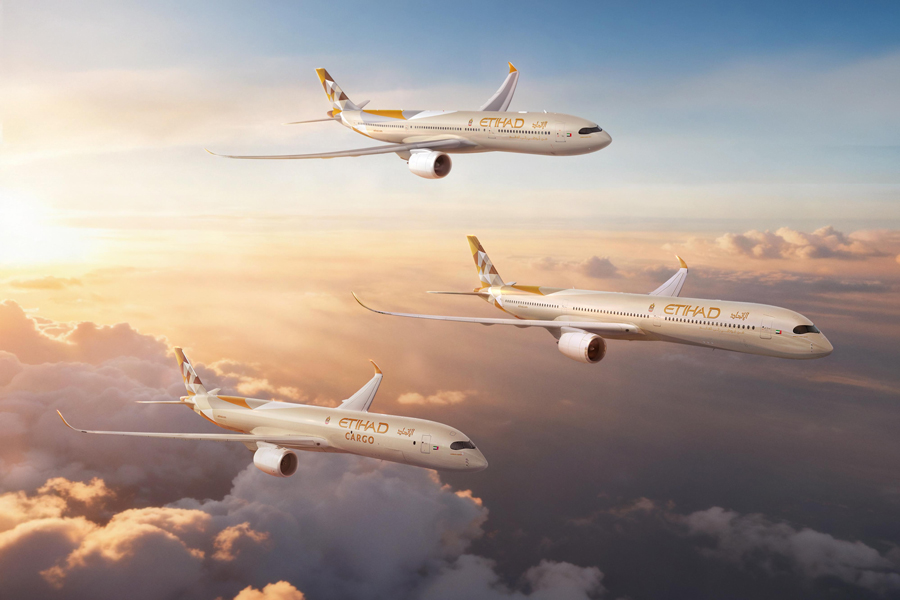
Etihad Airways has announced a substantial expansion of its Airbus wide‑body fleet by placing a firm order for six A330‑900neo aircraft — making it the latest carrier to adopt Airbus’s A330neo family — along with seven additional A350‑1000s (bringing its total A350‑1000 backlog to 27) and three A350F freighters (raising its A350F commitment to 10 aircraft).
Etihad’s CEO, Antonoaldo Neves, commented: “These aircraft strengthen our operations across medium‑haul, long‑haul, and cargo. The A330neo brings the right combination of efficiency and flexibility for our regional and mid‑range growth, while the A350‑1000 continues to deliver exceptional performance on our long‑haul network. The A350F freighter adds significant capability to our cargo division as global demand continues to expand. Our partnership with Airbus continues to play an important role in shaping our future fleet, and we are proud to be building one of the world’s most modern and efficient widebody operations.”
Benoît de Saint-Exupéry, Airbus EVP Sales for Commercial Aircraft, added that “Etihad Airways’ continued investment in our latest‑generation widebody aircraft is a testament to the strength of our partnership and the shared vision we have for the future of aviation in the UAE and beyond. The combination of the A350 Family and A330neo will deliver unmatched efficiency and flexibility to Etihad’s operations.”
The A330‑900neo offers up to 25% improved fuel efficiency over previous‑generation wide‑bodies and a range of up to 8,100 nautical miles — making it well suited for medium‑ to long‑haul routes in the Middle East, Asia and Africa. Meanwhile, the A350‑1000 further enhances Etihad’s long‑haul capacity with intercontinental range and modern efficiency, and the A350F freighters are expected to grow the airline’s cargo capabilities — an increasingly important segment given rising global demand for air freight.
Beyond its aircraft orders, Etihad also secured lease commitments for nine additional A330‑900neos, expanding its flexibility and accelerating delivery slots at a time when wide‑body availability remains constrained globally. This move underscores Etihad’s aggressive growth strategy and positions it to further strengthen Abu Dhabi’s role as a global aviation hub in the coming years.
Source: Airbus